
Shirodhara in Rishikesh, checked by a doctor first
Shirodhara is an Ayurvedic therapy in which a steady stream of warm medicated oil is poured onto the forehead while you lie still. At Divine School of Ayurveda in Muni Ki Reti, Rishikesh, it is given by trained therapists under the supervision of Dr. Mukesh Sharma and Dr. Vibha Sharma, either as a single session or as part of a treatment program. Many people find it deeply calming. Message the clinic on WhatsApp for today's price, or walk in any day between 10:00 and 20:00.
- Price
- Ask for today's price
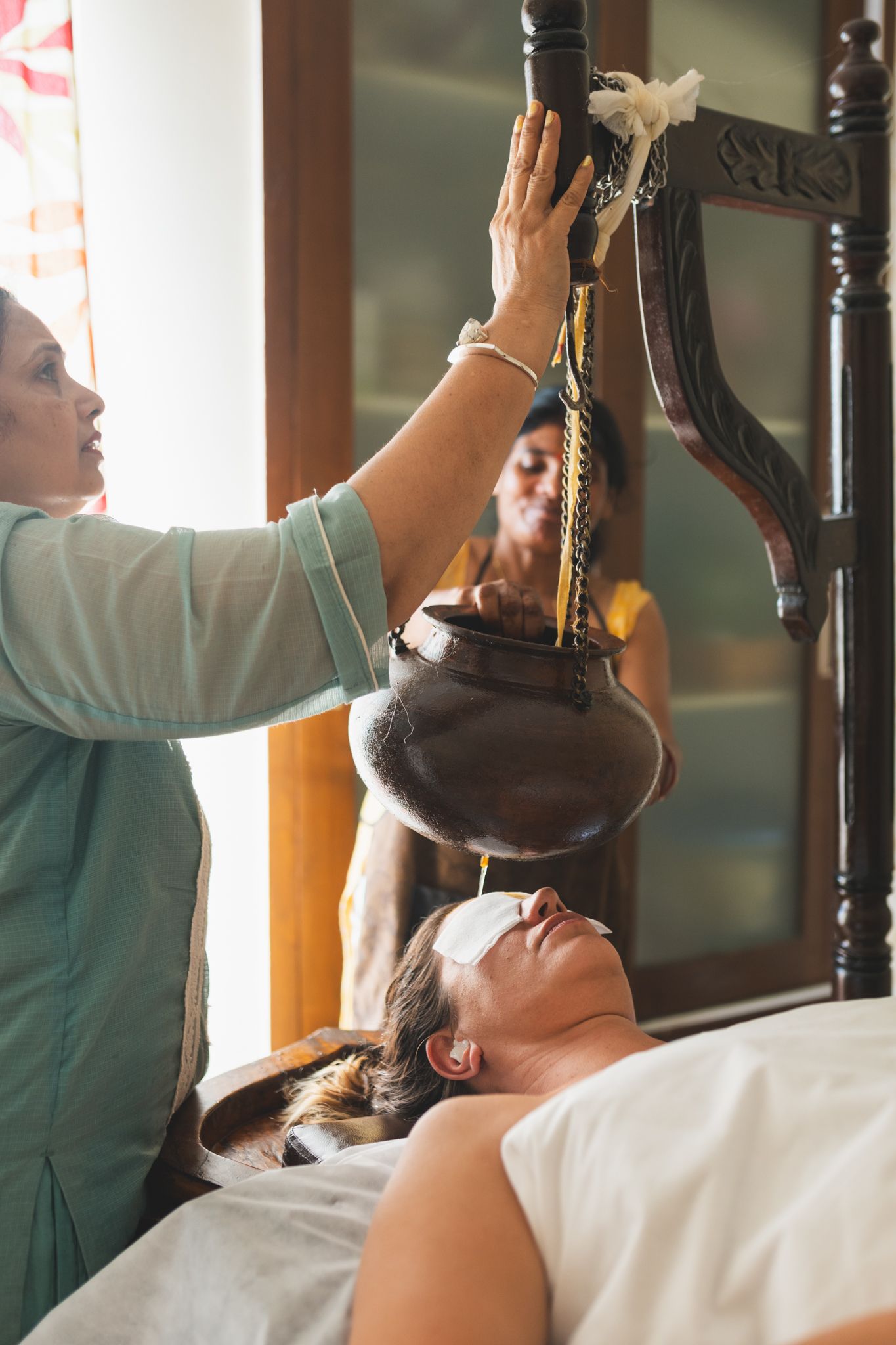
Shirodhara is the therapy most people picture when they think of Ayurveda in Rishikesh: a clay pot, a thin stream of warm oil, a person lying very still. It is simple to describe and easy to get wrong, so at this clinic a doctor checks you before the oil starts.
What Shirodhara is
Shirodhara is a continuous stream of warm medicated oil poured onto the centre of the forehead. “Shiro” means head and “dhara” means stream.
In a typical session you lie on your back on a wooden treatment table, with your eyes covered. The therapist usually starts with a short massage of the head and neck, then lets the oil flow from a pot suspended above you, moving the stream gently across the forehead. The oil is warm, not hot, and its temperature is checked throughout. Afterwards you rest for a few minutes before sitting up.
Malaysia’s Ministry of Health, which offers Shirodhara in some government hospitals as a complementary therapy, publishes a practice guideline that sets the flow itself at 30 to 45 minutes, within a session of 45 to 60 minutes including the massage and rest. Ask the clinic how long today’s session will be.
What people use it for
Many people find Shirodhara deeply calming. Traditionally it is used for sleep, stress, a restless mind and tension in the head and neck.
The research is still small. A 2013 study in the Journal of Ayurveda and Integrative Medicine followed 16 healthy volunteers and described a state of “alert calmness” after a standardized session, with improved mood scores and lower stress levels. A health technology review by Malaysia’s Ministry of Health found only very limited evidence for anxiety, insomnia and stress, all from small, short studies, and none for depression or headache.
So the honest summary is this: it is a pleasant, traditional therapy that many people find restful. It is not a treatment for a psychiatric condition, and it does not replace care from your own doctor. If sleep or stress is part of a wider picture, the doctors look at that picture; see lifestyle disorders for how they approach it.
A single session, or part of a program
You can have Shirodhara as a single session, or the doctors can include it in a treatment program on selected days. Both start with a check by the doctors.
A single session
Walk in or message ahead on WhatsApp. Before your first session, one of the doctors asks about your health, any conditions and your medicines, and chooses the oil. Then the therapist takes over. This is the right choice if you are in Rishikesh for a few days and want to experience it.
As part of a program
Within a treatment program, Shirodhara is one therapy among several, planned after a full consultation with Nadi Pariksha. It may follow abhyanga, or appear on certain days of a longer course such as Panchakarma. Programs cost around $120 a day including therapies, herbal medicines, Ayurvedic meals, daily doctor supervision and GST; accommodation is separate. The Malaysian guideline describes a course of 7 to 14 consecutive days; at the clinic, the number of sessions is decided by the doctors for each person.
Who should not have Shirodhara
Shirodhara is gentle, but it is not for everyone. The Malaysian guideline lists these contraindications:
- Pregnancy
- Low blood pressure (hypotension)
- Alcohol or drug dependence
- Acute psychiatric conditions, including psychosis, suicidal thoughts, mania, delirium or dementia
- Brain tumour, central or peripheral neuropathy, or peripheral arterial disease
- Recent neck injury, an open wound or inflammation on the head, loss of sensation, or acute sinusitis
- A flu-like illness
The same guideline notes possible side effects: neck or back discomfort and numbness from lying still, headache, light-headedness when getting up, a drop in blood pressure, allergy to the oil, and burns if the oil is too hot. That is why the oil temperature is watched and why you should speak up at once if anything feels uncomfortable.
If you are taking medicines for blood pressure, sleep or mood, tell the doctors before your session.
Before and after your session
Eat a light meal at least two hours before, not straight before. Wear clothes you do not mind getting a little oily, and bring a scarf or cap.
Afterwards, the Malaysian guideline advises waiting about two hours before a lukewarm shower, and keeping your head, ears and neck covered from sun, cold and wind for an hour or two. Plan a quiet rest of the day. Oil in the hair takes more than one wash to come out.
Booking a session
Walk in any day between 10:00 and 20:00 IST at C-6 Ganga Vatika Retreat, near Palm Bliss Hotel, Muni Ki Reti, or message the clinic on WhatsApp to fix a time and ask today’s price. If you are thinking about a longer program, start with a consultation. Directions are on the contact page, and current program pricing is on programs and pricing.
Questions people ask
Prices in Rishikesh vary with the oil used, the length of the session and whether a doctor is involved. At Divine School of Ayurveda in Muni Ki Reti, Shirodhara is available as a single session or as part of a treatment program, which costs around $120 a day including therapies, herbal medicines, Ayurvedic meals, daily doctor supervision and GST, with accommodation separate. Message the clinic on WhatsApp for today's single-session price.
Many people find Shirodhara deeply calming, and small studies have recorded lower stress scores and a relaxed state after a session. A 2015 health technology review by Malaysia's Ministry of Health found the evidence for anxiety, insomnia and stress very limited, because the studies were small and short. It is best understood as a traditional therapy that many people find restful, used alongside proper medical care rather than instead of it.
One session is enough to know whether you like it. When Shirodhara is part of a treatment plan, it is traditionally given on consecutive days, and Malaysia's Ministry of Health practice guideline describes a course of 7 to 14 days. At Divine School of Ayurveda, the doctors suggest a number of sessions only after a consultation.
Rest for a few minutes before getting up, and keep your head, ears and neck covered from direct sun, cold and wind for an hour or two. Wait about two hours before washing your hair with lukewarm water, and avoid cold drinks and heavy food straight afterwards. Plan a quiet rest of the day rather than a trek or a late night.
Shirodhara is not suitable during pregnancy, with low blood pressure, after a recent neck injury, with an open wound or inflammation on the scalp or forehead, with acute sinusitis or a flu-like illness, or with some neurological and psychiatric conditions. Tell the doctors about every condition and medicine before your first session so they can check it is right for you.